Drivers new to Dutch roads often miss the first visual cues that a surface has become slippery after rain. Small patches of standing water or darkened asphalt appear well before braking distances lengthen, yet many continue at the same speed until traction feels different under the wheels. The result is late reactions rather than planned reductions in speed.
Observation habits that work in dry conditions leave little margin once water is present. This article sets out the most frequent oversights and the sequence of checks that replaces them, drawing on standard traffic rules maintained by Rijkswaterstaat and local road authorities.
Reading asphalt colour before speed limits change
Dark streaks across a lane usually indicate recent rainfall has filled small depressions. On older sections of motorway these streaks form first in the wheel tracks, where the surface is polished. Newer porous asphalt drains faster, so the same amount of rain produces fewer visible marks; drivers must therefore look farther ahead for the transition points between the two surfaces.
A second cue is the reflection of overhead lighting or vehicle lights on the carriageway. When the reflection becomes continuous rather than broken, the layer of water is thick enough to reduce grip. Checking the mirror for following traffic at the same moment allows a smooth speed reduction without sudden braking.
Anticipating aquaplaning zones on multi-lane roads
Aquaplaning risk rises where water collects in ruts. These ruts are most common in the right-hand lane on routes carrying heavy goods vehicles. Moving to the centre lane early, when signs indicate rain, avoids the deepest channels. The manoeuvre must be completed before visibility drops, because spray from other vehicles then masks the surface.

Tyre tread depth directly affects the speed at which aquaplaning begins. The legal minimum remains 1.6 mm, yet many drivers wait until the tread wear indicators show before replacing tyres. In steady rain the difference between 2 mm and 4 mm tread can shift the critical speed by several kilometres per hour on typical Dutch motorway gradients.
Adjusting following distance when spray reduces visibility
Rear lights of the vehicle ahead become harder to see once spray rises above wheel height. A practical check is to count the seconds between the moment the vehicle ahead passes a fixed roadside object and the moment your own vehicle reaches the same object. Extending the interval from two seconds in dry weather to at least three seconds in rain compensates for both reduced visibility and longer braking distances.
Side mirrors also collect spray. A quick wipe of the mirror glass with the wiper stalk restores the view of traffic approaching from behind before any lane change is considered. This step is often omitted, leading to sudden steering corrections when an overtaking vehicle appears unexpectedly close.
Priority at junctions after rain begins
At unsignalised junctions the stop line or give-way line can become covered by leaves or mud washed across the road. Drivers who rely solely on painted markings may stop in the wrong position. Looking for the physical layout, such as the continuation of the kerb line or the position of reflector posts, provides a more reliable reference.
Cyclists approaching from the right retain priority in most cases. Their braking distance lengthens on wet surfaces, so an earlier glance over the shoulder is required. The check should occur before the vehicle reaches the point where the cyclist would enter the conflict zone, rather than at the last moment.
Using roadside markers to judge lane position
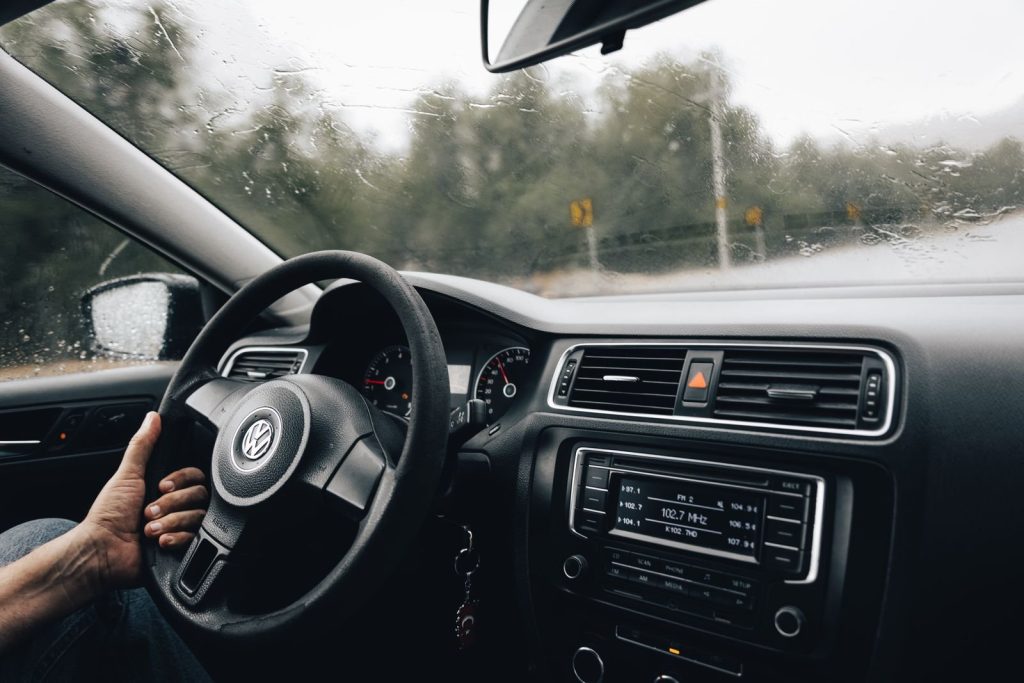
Cat’s-eye reflectors and raised rib lines remain visible when painted lane markings fade under water. On curved sections these markers also indicate the correct entry speed: if the reflectors appear to move outward in the windscreen view, speed is still too high for the radius ahead. Reducing speed until the markers track steadily maintains lane position without abrupt steering.
During prolonged rain the reflectors themselves can be obscured by dirt. In that situation the edge of the hard shoulder or the line of emergency telephones provides the next reference. Maintaining at least one metre clearance from that edge keeps the vehicle within the drivable width even when markings are lost.
Sequence of checks before any speed or position change
Before altering speed or lane, complete three observations in order: surface colour and reflection ahead, mirror check for following traffic, and shoulder glance for cyclists or merging vehicles. Only after these three steps is the accelerator or indicator used. Repeating the sequence at every change in conditions prevents the most common sequence of errors—late braking, mirror omission, and side collision.
The same order applies when leaving a motorway. Surface changes at the exit slip road are often sharper than on the main carriageway because the slip road receives less maintenance traffic. An earlier reduction to the posted advisory speed gives time for the three checks before the radius tightens.
Boundary between normal caution and over-reaction
Excessive speed reduction in light rain can itself create hazards by obstructing flow. The distinction rests on visible water depth rather than the presence of rain alone. When reflections are broken and no spray is thrown by other tyres, normal motorway speeds remain appropriate provided following distance is increased. When reflections become continuous or standing water is visible in the distance, speed must drop regardless of the posted limit.
Local variations matter. In coastal provinces salt spray from the sea can reduce grip even without rainfall. The same visual checks apply, though the surface may appear dry. Drivers who treat every rain shower identically and ignore regional differences tend to brake later than necessary on salted roads and earlier than needed on porous asphalt in light rain.