Learners often misjudge the space needed beside tram tracks on Dutch streets, leading to unnecessary corrections or conflicts with other road users. Correct positioning starts with recognising the raised or flush track edges and the white markings that indicate clearance zones.
Tram infrastructure appears in many city centres and some suburbs. Drivers must treat the tracks as a fixed feature that narrows usable road width, especially when other vehicles or cyclists are present. The following sections outline recurring errors and practical adjustments based on standard Dutch road layout rules from the RDW and local traffic authorities.
Recognising track edge markings and clearance indicators
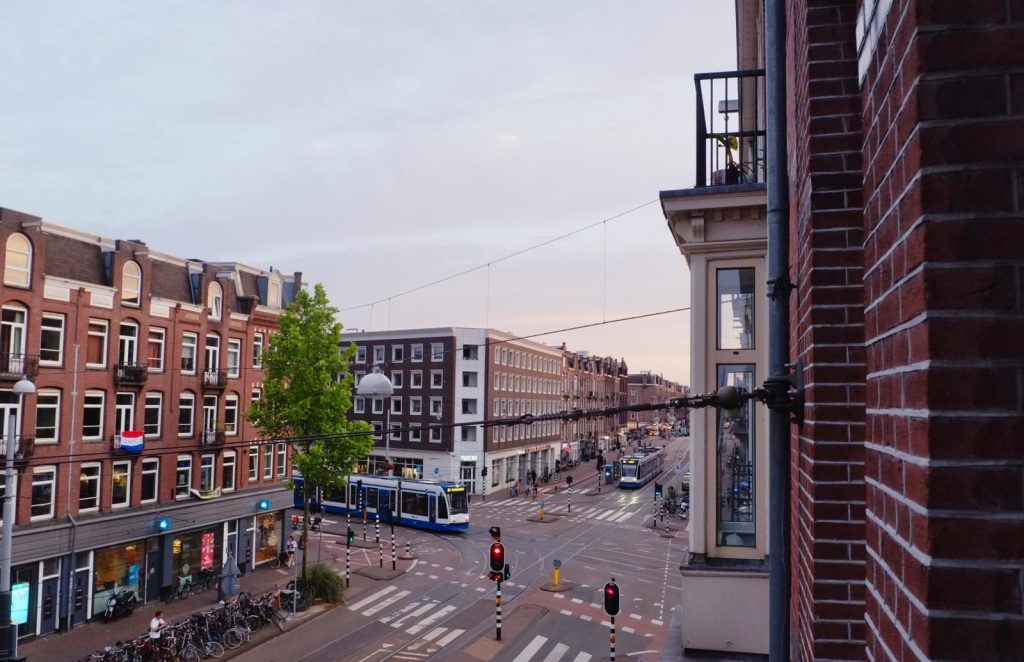
White lines or hatched areas beside tram tracks show the minimum distance vehicles should keep. A common error is treating these lines as optional guidance rather than indicators of where the tram body extends. When tracks run in the centre of the carriageway, the hatched zone usually marks the area where a car door or mirror could strike the tram if opened or if the vehicle drifts.
Check the position of the tracks relative to the kerb before entering the street. In streets where tracks sit flush with the asphalt, the edge is still defined by a change in surface texture or a narrow painted line. Drivers who focus only on the tram itself miss the static reference points that remain visible even when no tram is approaching.
Keeping consistent lateral position in moving traffic
Many drivers drift toward the tracks when checking mirrors or when traffic in the adjacent lane moves faster. This reduces the buffer on the track side and increases the chance of a wheel dropping into the groove. Maintain the vehicle centre line parallel to the outer edge of the track marking rather than aligning with the centre of the lane.
Use the left or right door mirror to confirm the distance to the track edge at regular intervals. In narrow streets the correct offset is often one metre or more from the nearest rail, depending on local signage. Adjust earlier rather than correcting late, because sudden steering inputs near tracks can cause loss of traction on the smooth metal surface.
Adjusting for wet or icy track surfaces
Rain turns the metal rails into low-grip strips. A frequent mistake is braking or accelerating at the same points used in dry conditions. Reduce speed before reaching sections where tracks curve or cross the driving line, and increase following distance to allow for longer stopping distances.
Look ahead for standing water along the tracks. Water hides the exact rail height and can cause aquaplaning if a wheel rides along the rail. If the road camber directs water toward the tracks, move slightly farther from them while still staying within your lane markings.
Sharing space with cyclists and other vehicles
Cyclists often ride between the vehicle lane and the tram tracks. Drivers who position too close to the tracks leave insufficient room for cyclists to pass safely. Observe the full width of the available carriageway and leave a consistent gap on both sides of the vehicle.
When a tram stops, other vehicles may pull out suddenly. Keep an eye on the nearside mirror for cyclists moving into the space beside the tracks. If the layout forces a choice between moving closer to the tracks or closer to parked cars, the safer option is usually to hold position and reduce speed until the obstruction clears.
Approaching junctions and stops where tracks change direction
Tracks that turn at junctions require earlier lane discipline. Drivers who wait until the junction to decide their position often end up straddling the rail. Plan the exit path while still fifty metres before the junction and align the vehicle so that all wheels remain on asphalt, not on the rail.
At tram stops the platform edge may narrow the carriageway. Check for temporary cones or signs that alter the normal clearance. If the stop is on the opposite side of the road, maintain your position and do not cross the tracks unless road markings explicitly permit it.
Practising observation routines on familiar routes
Repeat short sections of route that contain tram tracks while varying the time of day and weather. Note the points where position tends to slip and mark them mentally as trigger points for a mirror check. Over several drives the correct offset becomes automatic.
Combine this with commentary driving: state aloud the distance to the nearest rail and the location of any cyclists or following vehicles. This verbal step reinforces the visual scan without adding extra mental load during the drive.
Limitations of general rules in specific layouts
Some older streets have non-standard track placements where the standard one-metre clearance cannot be maintained. In these cases local signs take precedence. If no sign alters the rule, reduce speed and treat the section as a single-track passage, waiting for oncoming traffic to clear before proceeding.
Rules remain the same regardless of vehicle type. Larger cars and vans need proportionally more space, yet the observation method stays identical. Regular review of the current RDW guidance on road markings ensures any layout changes are noticed early.