

A different lesson car can make a familiar skill feel awkward again. The mirrors frame the road differently, the pedals respond in a new way and a control you used without thinking now requires attention. That does not automatically mean your learning has gone backwards. It means the environment has changed. Agree a short familiarisation plan with your instructor so that you can distinguish adaptation to the vehicle from a genuine gap in observation or decision-making.
Ask what has changed before the lesson starts
Find out whether the replacement is temporary and whether there are important differences in transmission, controls or dimensions. Tell the instructor what you normally drive and which controls you already understand. A short conversation gives the lesson a realistic starting point. It also prevents an avoidable misunderstanding in which a learner appears hesitant because they are searching for a switch that the instructor assumes they have already located in the stationary car.
Do not use a change of vehicle as a reason to compare yourself with another learner or to make predictions about an exam result. The useful comparison is between your own decisions before and after familiarisation. You may regain confidence quickly with one control and need more supported practice with another. Recording the specific adjustment is more constructive than describing the entire lesson as either a success or a failure based on its first few minutes.
Set up the driving position deliberately
With the vehicle safely stationary, work through the seat, head restraint, steering position and mirrors with your instructor. Familiar habits from the previous car may not transfer exactly. Ask how to assess whether the position allows comfortable control and a useful view, rather than memorising a seat-setting number. A setting that belonged to another vehicle is not a general rule about where your hands, eyes or feet should be in this one.
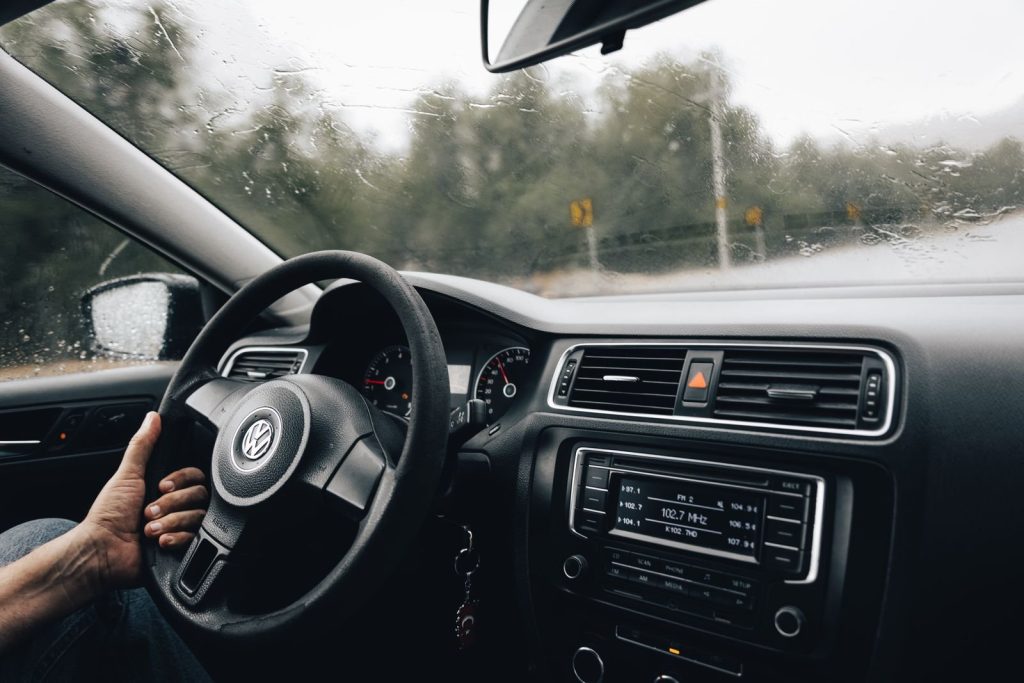
Locate the controls you are likely to need during the planned lesson before moving off. These may include lights, wipers, demisting and hazard warning lights. Ask for an explanation of unfamiliar displays. Avoid trying a series of switches while driving merely to discover what they do. The purpose of stationary preparation is to reduce unnecessary searching once your attention belongs on the road and on the instructor's guidance about the situation ahead.
Use an appropriate opening route
Discuss whether the first part of the lesson should revisit a manageable setting before progressing to a demanding task. Your instructor can judge an appropriate route and level of support. The point is not to create a long ritual for every replacement car. It is to provide enough space to notice differences in control response without combining them immediately with a situation that already uses most of your available attention.
During the debrief, distinguish what you felt from what actually happened. You might describe a pedal as unfamiliar, then ask the instructor whether your control was smooth and appropriately timed. That invites actionable feedback rather than a vague reassurance. If a manoeuvre felt harder, identify whether the issue was vehicle position, observation, judgement or a control adjustment. The next practice task should follow the diagnosed difficulty rather than simply repeating the whole route.
Keep observation separate from vehicle habits
It is easy to focus so strongly on the car that the rest of the driving task recedes. Tell your instructor if operating an unfamiliar control is consuming too much attention. They can adapt the lesson instead of allowing confusion to accumulate. Familiarisation should support your view of the road, not become an excuse to ignore it. A helpful learning question is which vehicle tasks can be settled before moving and which require guided practice in context.
Avoid treating a camera, sensor or display as a direct substitute for a skill developed in the previous car. Ask what the equipment does, what it does not show and how your instructor expects you to integrate it into observation. Equipment can differ between vehicles that otherwise look similar. Understanding its purpose is more transferable than learning a routine that depends entirely on one screen, one warning sound or one unusually convenient mirror position.
Plan around the transmission and training route
If the transmission type has changed, discuss the implications for your lesson plan and intended licence route before assuming the sessions are interchangeable. Check relevant administrative questions with your school and official licensing information. The important practical point is to make an intentional choice. A temporary vehicle arrangement should not quietly change the training objective, the preparation you need or the understanding you have about which test you are working towards.
Where the transmission stays the same, there can still be differences in how controls feel. Describe them without inventing universal rules such as every car of this brand needs a particular technique. Use the vehicle's instructions and your instructor's demonstration. Your longer-term goal is to understand a safe adjustment process that can be applied to another unfamiliar car, not to accumulate a collection of confident but unreliable shortcuts associated with badges or models.
Review the adaptation, then return to the main goal
At the end, write a small note with three parts: what was different, what adjustment helped and what still needs practice. Keep the rest of your progress record intact. If junction judgement has improved over several weeks, one hesitant start in a replacement car does not erase that history. Equally, feeling more comfortable in a new seat does not automatically resolve an observation issue your instructor has identified independently of the vehicle.
For the next session, agree whether further familiarisation is necessary and how it connects to the main lesson objective. This prevents the replacement car from taking over your entire learning narrative. A change of vehicle can become useful practice in preparation, communication and adaptation. The benefit comes from separating those tasks clearly, giving them appropriate support and then bringing your attention back to the road skills that need to work in any suitable car.